Thursday, November 4, 2010

S is for The Serpent Garden

The Serpent Garden by Judith Merkle Riley

Another review I did for Historical Novels Review:

Riley’s exquisite tale The Serpent Garden begins in England in 1514 and follows the life of Susanna Dallet, daughter of a Flemish artist. Susanna is widowed when her unsavory husband is murdered by his lover’s spouse. Before his death, Mr. Dallet was part of a group who recovered a long lost manuscript that threatens to rip apart the French monarchy. Because of her husband’s role, Susanna is unknowingly thrust into peril, caught in the middle of conspirators who will stop at nothing to possess the complete manuscript.


As a widow, Susanna is left to make her own way in the world, no easy feat in the16th century. She begins by painting less than innocent Biblical scenes and portraits in miniature. Soon she is introduced to Cardinal Wolsey who employs her and sends her to France with Princess Mary Tudor’s wedding party to paint the festivities of the union of Mary and the aging Louis XII.

Susanna possesses an extraordinary gift for painting in miniature and is welcomed into the French court, a place full of schemes at every turn. Riley adds a good dose of the supernatural to the story with a demon named Belphagor who was released when the manuscript was unearthed. Belphagor’s goal is to cause chaos, and Susanna becomes a target for the demon’s wrath because of her association with the manuscript.

Riley packs quite a bit into the novel and achieves a nice blend of romance, intrigue, politics, and fantasy. The narration alternates between Susanna Dallet and third person viewpoints which may take a bit to get used to, but soon readers will find themselves engrossed in the tale. Susanna’s sense of humor and the depictions of the French court are only two of the aspects that make this a novel not to be missed.

R is for The Rebel Princess

The Rebel Princess by Judith Koll Healey

Here's a review I wrote for Historical Novels Review:

Healey (The Canterbury Papers) brings readers the second installment of the story of Princess Alaïs Capet, sister to King Philippe Auguste of France. Set in 1207, the tale begins as the court of King Philippe is awash in conspiracies. Alaïs’s aunt, the dowager countess Constance of Toulouse, is acting secretive, the king does not know which of his ministers he can trust, and two monks dispatched by the pope in hopes of persuading the king to support stamping out the Cathars, a Christian sect in the south of France, arrive at court. King Philippe turns to his beloved sister Alaïs for advice. Alaïs vows to help her brother and uncover the mischief at court. What she really longs to do though is finally reunite with and settle down with her lover, William of Caen, and reveal to Williams’ ward, Francis, that she is his mother. The plot deepens when the St. John’s Cup, a relic sacred to the Cathars, is stolen. Following the cup’s disappearance, Constance is absent from court, and Francis is kidnapped. Alaïs takes matters into her own hands and devises a way to search for her son, risking her life and rebelling against William’s explicit instructions to stay at court.


The Rebel Princess is a fast-paced historical mystery with plenty of suspense and intrigue. With every turn of the page there was the threat of bloodshed due to the rising conflict between the bishops and the Cathars. Healey does a fantastic job rendering the touching story of the intense bond between Alaïs and her son. Equally compelling is the exploration of Alaïs’s regret over the harsh parting words between her and William. I am looking forward to more in this series and hope that the love story between William and Alaïs unfolds even more. A very enjoyable read.

Wednesday, September 8, 2010

Q is for The Queen's Devotion

Jean Plaidy has always been one of my favorite historical fiction writers.  The following is a review that appeared in Historical Novels Review

The Queen’s Devotion, a novel in Plaidy’s Queens of England series, is a reprint of the previously published William’s Wife, and depicts the story of Queen Mary II. When the novel opens, Mary and her younger sister, Anne, are carefree princesses with loving and devoted parents. The girls’ father, the Duke of York, is in line for the throne if their uncle, King Charles II and his wife fail to produce a male heir. Because of the tumultuous political and religious climate in England, the girls are raised as Protestants. Mary and her sister are blissfully unaware of the trouble that is looming in the future. Once Mary turns fifteen, her life changes when her father informs her that she will be marrying her cousin, William, Prince of Orange, and will be moving to his homeland of Holland.


Mary is very young and naïve when she is married and feels that her world has been turned upside down- she is unhappy with the ladies accompanying her to her new home, she must leave behind her beloved father and sister, and she does not like her husband, who treats her very coolly.

When Mary’s uncle, the king, dies without an heir, her father becomes King James II. Unpopular with the people because he is a Catholic, numerous plots begin to brew. As time goes on, rumors drift their way across the Channel, and Mary realizes that soon she will have to choose between her loyalty to her father or her husband.

Plaidy’s detailed writing style evokes sympathy for Queen Mary. She effectively writes of the prominent scandals that were sprinkled throughout the queen’s life and superbly shows the tension and guilt that Mary faces, as she and William eventually become the co-regents of England.

Tuesday, August 10, 2010

P is for Portrait of an Unknown Woman

I absolutely loved this book by Vanora Bennett.  I ended up listening to it on audiobook, which I highly recommend because the narrator, Josephine Bailey, has such a pleasing voice.  Thomas More really came alive for me in this book.  You definitley get to see another side to him.  Here's the description from the book:

In the year 1527, the great portraitist Hans Holbein, fleeing the Protestant Reformation, comes to England under commission to Sir Thomas More. Over the course of the next six years, Holbein paints two nearly identical portraits of the More family, his dear and loyal friends. But closer examination of the second painting reveals several mysteries. . . .

Set against the turmoil and tragedy of Henry VIII's court, Portrait of an Unknown Woman vividly evokes sixteenth-century England on the verge of enormous change—as viewed through the eyes of Meg Giggs, More's intelligent, tenderhearted, headstrong adopted daughter, who stands at the center of this sweeping, extraordinary epic. It is a tale of sin and religion, desire and deception—the story of a young woman on the brink of sensual awakening and a country on the edge of mayhem.

I started her latest book, The Queen's Lover, a few months ago, but I couldn't get into it.  I will try again later.  I have her second novel, Figures in Silk, waiting on my bookshelf.  So many books, too little time!

Wednesday, August 4, 2010

O is for O, Juliet

Robin Maxwell is one of my favorite authors.  I especially love the cover of this one.  I had the pleasure of reviewing this novel for Historical Novels Review back in February.  Here is my review:

Maxwell delivers a mesmerizing retelling of the famous star-crossed lovers, Romeo and Juliet, in her latest novel, set in Italy at the beginning of the Renaissance. Juliet Capelletti is a headstrong, intelligent young lady who is facing an arranged marriage to Jacopo Strozzi, her father’s new business partner. She does not look forward to her match but knows that it will make her parents happy. Juliet’s entire future is forever changed one night at the engagement party of her best friend, Lucrezia, when she meets the handsome Romeo Monticecco. Romeo is at the party to seek reconciliation between his family and the Capelettis, who have been feuding and retaliating against each other for years. Juliet and Romeo find a chance to talk together alone under the stars and their destiny unfolds. Both are surprised by the other’s passion for poetry and shared interest in Dante Alighieri’s Vita Nuova. After their first meeting, Juliet is determined to find a way out of her upcoming marriage to Jacopo, even though this means defying her family’s wishes for her and possibly destroying the business between her father and her betrothed.


What unfolds is a beautiful love story between the soul mates Romeo and Juliet. Maxwell realistically portrays the torment that Juliet is faced with as she wonders what her future holds. One of the things I enjoyed the most about the novel was how Maxwell drew parallels between Dante and his love, Beatrice, and Romeo and Juliet and her use of poetry and quotes from Dante throughout the novel. Readers will savor this exquisite and magical love story.

N is for ???

Well, I am embarrassed to say that after flipping through my lists of books that I've read over the last several years and scouring my bookshleves at home, I have never read any historical fiction who's title begins with the letter N nor have I read anything by an author with a last name that begins with N.  I'm going to have to remedy that and come back to this one!  Meanwhile, you can check out what others who are doing the Challenge have read at Historical Tapestry's alphabet challenge.

Wednesday, June 9, 2010

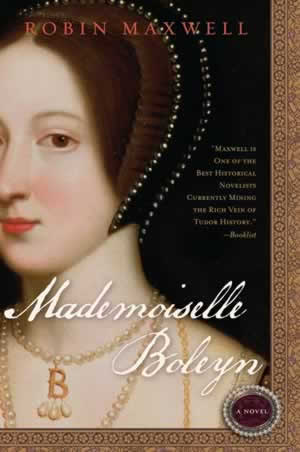
M is for Mademoiselle Boleyn

By far one of the best historical fiction novels I've ever read is Mademoiselle Boleyn by Robin Maxwell.  I am always on an Anne Boleyn kick, both fiction and nonfiction, so I try and read everything written about her.  Robin Maxwell masterfully conveys the story of young Anne Boleyn’s life in the care of the scandalous court of France while her sister, Mary, becomes a mistress to the king of France. After seeing first hand the disgrace and unhappiness of her sister, Anne decides that she will not suffer the same fate. The novel focuses on Anne’s early life, ending before she becomes involved with Henry and sets the stage for Anne’s later ideas and beliefs.

One of the best things about this book is the fact that it focuses on Anne's life before she met Henry, so it's like the reader is able to see a different side of her.  Maxwell makes Anne so accessible that by the end of the book, you feel like you know her.  I loaned this book to my sister-in-law, and she asked me to get her more like this one!